I have another pair of spruced-up shorts to share. This project was inspired by Emma at Food Coma. I loved her southwestern shorts and the idea of adding fun fabric to denim shorts. I stowed that idea away in my brain for awhile, then came across these linens (placemats, maybe?) at an antique store for two dollars, and thought they would be a perfect addition to my little ol' shorts. The fabric is just cut to fit the shorts, then sewn on... with a little fringy fringe at the bottom!
Showing posts with label DIY. Show all posts
7/12/12
7/11/12
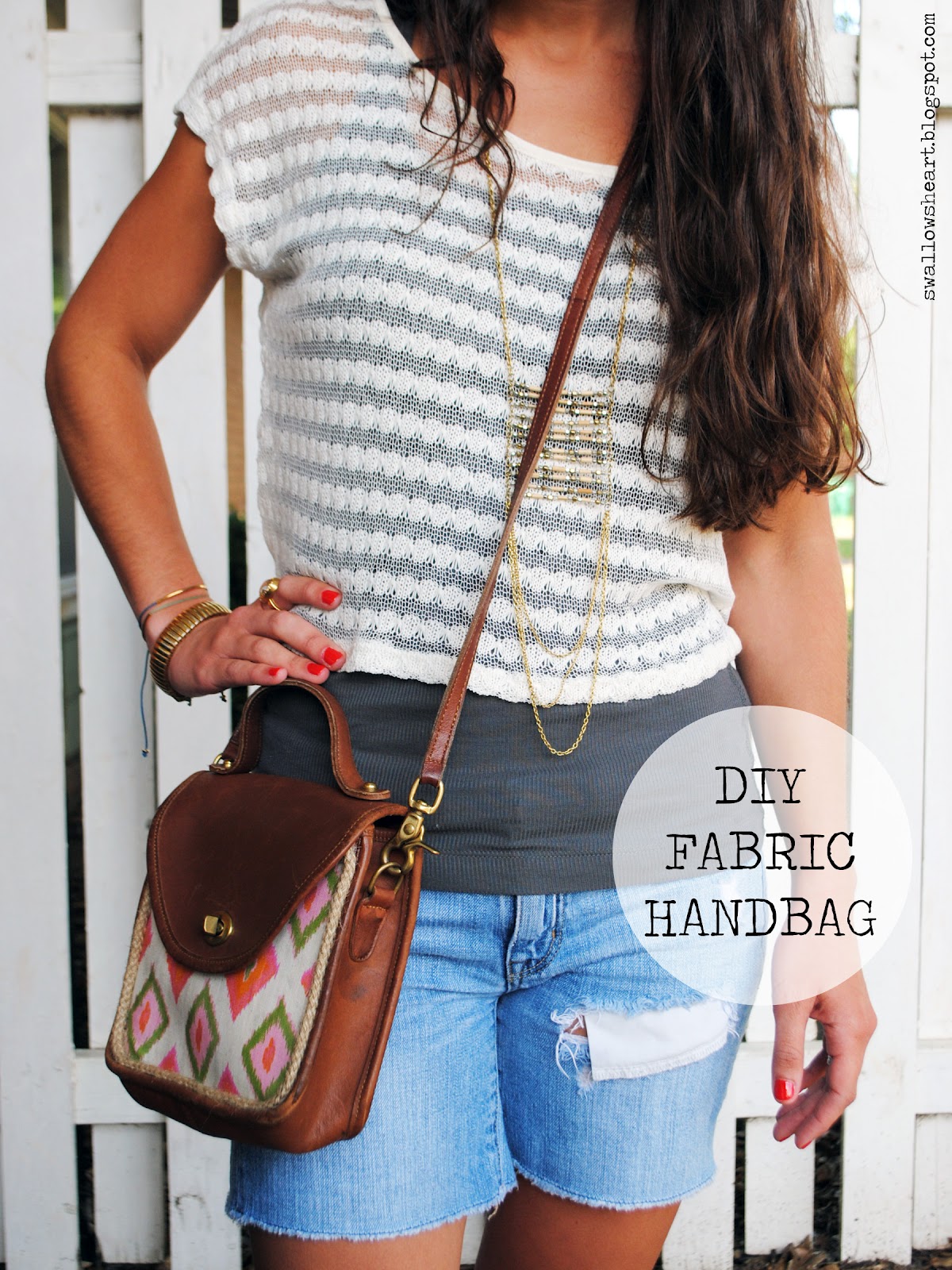
{DIY} Custom fabric handbag
This DIY fabric handbag is so customizable and can be as cheap or expensive as your tastes. This leather purse was found for $4 at the thrift store on post; the fabric was about $1.50/yd on sale (I only got a yard); and that rope cord was about a dollar as well. I already had the glue, painters tape, and paintbrush on hand.
1. Stuff the inside of the handbag with grocery bags for an even working surface. Line the edges & the center fastener with painters tape.
2. Lay a slightly oversized piece of the fabric on top of the surface and, using an x-acto knife, cut a small hole around the center fastener.
3. Use the Mod Podge to adhere the fabric to the handbag, starting at the center and working your way out. Paint a layer of Mod Podge on top of the fabric that you've just adhered. Take your time with this and press down on the Mod Podged fabric for a few seconds to secure it. Press down with the end of a paintbrush when adhering the edges/creases.
4. Using the x-acto knife, slowly cut the fabric to fit the handbag, lifting up on the fabric as you cut. The edges will be rough. Not to worry though- the rope or cord will hide it. Remove the painters tape.
5. Line the cord/rope on the edge of the handbag over the rough edges of the fabric. Begin gluing the rope to the fabric/leather, pressing down as you go.
6. Once you've lined all of the edges, cut the rope at your starting/ending point for a seamless look.
7. Let dry per instructions on the glue packaging.
6/20/12
{DIY} Pallet planter
From Pinterest, I found the tutorial for this pallet planter at the Kelly Moore blog - it's so easy and very well explained, so just hop on over there if you want to make one of these for yourself. Here's our version:
5/16/12
{DIY} Mustache mugs
A look at our recent 'stache project...
Supplies: plain mugs (ours are from Target but I think it would be fun to thrift a few different styles/colors) and a black paint pen (Vitrea 160 from Michaels - it's dishwasher safe!)
1. First choose your mustache designs. To better visualize them, we Sam sketched a few famous 'staches first. I thought this was the fun part, although I don't know how Hitler made the list (I mean, technically he does have a famous 'stache, but who wants Hitler in their kitchen?).
We picked these four dapper dudes: Wyatt Earp, Albert Einstein, Charlie Chaplin, and Mario (of the brothers)
2. Using the glass pen, draw a mustache per mug. Sam is an awesome freehand artist, so he drew ours. If you're like me and are worried about messing up, try practicing a bit with a sharpie beforehand. Also, make sure the glass pen is all inked up before you begin drawing on the mug! After painting, just follow the directions on the pen packaging for baking times, etc.
3. If you're hanging your mugs, prepare your area. Our plan was to build a chalkboard for the kitchen... then we came across one at Ikea for $15 and thought it was a better deal/cheaper than what we could do ourselves. The Ikea shelf didn't have come with appropriate hooks for our style of mugs, so we just picked up a pack of white mug hooks from Lowes and installed them ourselves.
4. And here's the finished project!
4/23/12
{DIY} Painted wooden necklace
As soon as I saw a tutorial for making a necklace out of painted wooden beads, I was in. It has everything I love: a geometric vibe, customized colors, chunky beads. This project is from here, but I tweaked the steps just a bit. Here's what I did...
Supplies: small wooden beads (got mine at Michaels), paint, painters tape, paintbrush, necklace chain
I used three colors (mint, coral, and gold) for my necklace, but you can really use more or less if you want. I just browsed the paint section at Michaels and kept coming back to good ol Martha Stewart. I would've preferred to have all three colors in the same finish, but no such luck at our Michaels. Finally I decided that the colors were more important to me than the finish. So, I bought: "wild salmon" in satin, "mint chip" in pearl, and "yellow gold" in metallic.
I used twelve wooden beads, four of each color. First I painted only two gold beads, but after stringing all of the finished beads on my necklace, I thought it needed a little more.
1. First begin by wrapping a 3" piece of painters tape around half of each bead (shown above). The tape is longer than the bead... this makes it easier to both hold onto the bead while painting and creates a stand for the beads while drying.
2. Hold onto the painters tape and paint the exposed wooden part of each bead.
3. Let beads dry completely on their painters tape stands. I painted 3-4 coats per bead.
4. Once beads are completely dry, peel the painters tape off slowly, pulling downward as you go.
5. String the beads onto your necklace chain with like-colors facing inward towards each other (just check out photo 6 for a visual). Check out Goodwill or a flea market for a cheap, thrifted necklace chain if you don't have one laying around. Cheap, cheap, cheap!
6. Enjoy with a cute spring outfit!
4/12/12
{DIY} Gnome garden markers
Our little garden was missing some garden markers, so after browsing around the Internet a bit, I eventually stumbled upon this blog with a post about creating hand-carved garden gnomes from twigs. I loved the gnome idea and especially the natural look, so I adapted this project just a bit. Here's a little tutorial in case you are in need of some gnomies in your garden, too!
Supplies: varying sizes of twigs, knife (we used a Swiss Army pocket knife), craft paint (I used red, yellow, blue, green), paintbrush, permanent marker
1. Use your pocket knife to carve a pointed "hat" at the top of one end of a twig. Just keep whittling away until you end up with a pointed triangle. It doesn't have to be super smooth. Our "hats" were approximately 1 inch tall.
2. Carve a rounded, flat "face" on one side of the twig. We varied the size of the faces on the different twigs, but the faces averaged about 1.25 inches tall x 1 inch wide.
3. This is what you end up with after steps 1 & 2... a pointed hat and a flat face.
4. Carve a rounded, flat area on the bottom part of the stick (just like the face, but in the opposite direction). This is where you will write the names of your plants, so if you have veggies with long names (like "cucumbers" or "strawberries" etc), make sure to use a few longer sticks and carve appropriately.
5. Here's what you end up with after all the carving is complete! Repeat steps 1-4 for all of your twigs.
6. A trio of gnomes ready to be painted (we later added a fourth; and will need a few more later).
7. Paint your gnomes' hats and beards in any color you desire! If you use all red hats/white beards, you will end up with Santa Claus look-a-likes. ;) We went for bright colors since they would be planted in the dark dirt.
8. Let dry completely. If your twigs don't stand up on their own, poke holes in the bottom of a cardboard box so they can dry without smearing paint.
9. After your twigs are completely dry, write the veggie names onto the bottom part of the twigs with a permanent marker. I don't like my handwriting enough to commit to this, so my husband wrote ours. Haha. No worries - if you mess up, you can always whittle away the top layer and start fresh.
10. Here's what you end up with!
Keep your gnome friends safe... because dogs don't know the difference between them and regular sticks. Mine required a little rescue action before planting.
11. Dig a small hole near the corresponding plant and enjoy your new garden friends.
3/23/12
{DIY} Burlap sacks into art
While browsing an indoor flea market a few weeks ago, we found these two large old coffee sacks (originating from Colombia) for $7 each. Since we have lots of empty walls and a small budget for house projects, we decided to build wood frames and transform these coffee sacks into art. If you already own the tools, this is an inexpensive way to use a lot of space on a wall.
Supplies needed: old burlap sacks (check a local flea market or eBay), 2 pieces of neutral/thin fabric the same size as the burlap sacks, wood (depends on the size of your burlap sacks; we used two 2x2x8 pieces), ataple gun and (LOTS of) staples, screws, scissors or pocket knife, jigsaw, drill
Before building the frame, measure the burlap sacks. For example, if your burlap sacks are 26" tall, your frame will need to be 20" tall to allow space (3" top & bottom) to wrap the fabric around the wood.
1. Use a jigsaw to cut the wood to the appropriate measurements. You'll need 5 pieces per frame (see photo on the right). For a frame that's 20x30" (like ours), you'll need two 30" pieces (for the height) and three 17" pieces (for the width). Note: the three 17" pieces are shorter than 20" to account for the thickness of the wood. 2. Use the drill to connect all of the pieces together, like in the photo on the right. Start by making the square first, then add in the middle piece last. 3. This is what you should end up with - wooden support frames.
Cut the feed sack in half. 1. Trim the rough edges with either a pocket knife (what we used) or scissors. 2. Next, layer from bottom to top: burlap sack face down, thin fabric (the purpose of this is to help with tightening and to give it a more finished look if the burlap sack has holes in it), wood frame. 3. Fold both layers of fabric over the wood frame tightly and begin stapling. It works best to staple a few in the top middle of the wood, then a few more in the bottom middle, and then the side middles - and then fill in around the rest of the frame. 4. If the burlap texture is really coarse (like ours), it helps to staple in various directions (a few horizontal, a few vertical). Continue stapling until all of the edges lay flat against the back of the wood frame and are all secure.
This is what the finished coffee sacks look like once stapled to their new wooden frames. Now you're ready to place the art in its new home! You can hang them (just attach a sawtooth picture hanger on the back) or rest them against the wall on a table. Wouldn't these be fun in the kitchen by the coffee maker?
We hung our art in the living room, where we've been inspired by travel and such. These two pieces fit right in.
3/22/12
Refreshing mint/lemon/cucumber water
If you're anything like me, sometimes regular ol' water needs a bit more. I tried natural flavor recently. I'm all about this mint/lemon/cucumber water - it's totally refreshing, light, and subtly flavorful. Also, check out the health benefits of lemon water here. Win win win.
Ingredients:
1 cucumber, peeled and thinly sliced
2 lemons, thinly sliced
8-10 mint leaves
To one gallon of water, just add in the sliced cucumber + lemons and mint leaves. The mint infuses with time, so it's best to let this steep in the fridge overnight. Serve cold and enjoy!
![]() |
Subscribe to:
Posts (Atom)